
Article
Travel & Accessibility
Accessible Tourist Services in Italy
Italy is a wonderful destination for families, and with the right preparation, children with special needs can enjoy its culture, history, and beauty comfortably and confidently.
Before You Book
- Contact your chosen hotels directly and ask specifically about roll-in showers, lift dimensions, and ground-floor room availability — don’t rely solely on website accessibility labels.
- Book tours through operators registered with Sage Traveling or Accessible Italian Holiday, both of which specialize in disability-friendly itineraries.
- Request a disabled parking permit (Contrassegno) equivalency letter from your home country’s transport authority — Italy honors EU and many international permits.
- Email major museums (Uffizi, Vatican Museums, Colosseum) in advance to arrange priority entry and sensory-friendly visit times where available.
- Consider travel insurance that explicitly covers pre-existing conditions and medical equipment loss or damage abroad.
Getting Around Italy
- Trenitalia offers free travel for one accompanying carer when a passenger holds a certified disability of 100% — apply at any staffed ticket office with documentation.
- Request boarding assistance at train stations at least 24 hours ahead via the Sala Blu service (call 800 906 060, free from Italian numbers).
- In Rome and Milan, low-floor trams and metro Line C are the most wheelchair-accessible public transport options — Line A and B have limited lift coverage.
- Pre-book adapted taxis (taxi disabili) through local taxi apps like itTaxi by selecting the accessible vehicle filter.

At Major Attractions
- The Colosseum has a dedicated accessible entrance on Via Sacra — skip the main queue entirely by showing documentation at the side gate.
- Vatican Museums provide free wheelchair loan at the entrance and offer a shortened accessible route that still covers the Sistine Chapel.
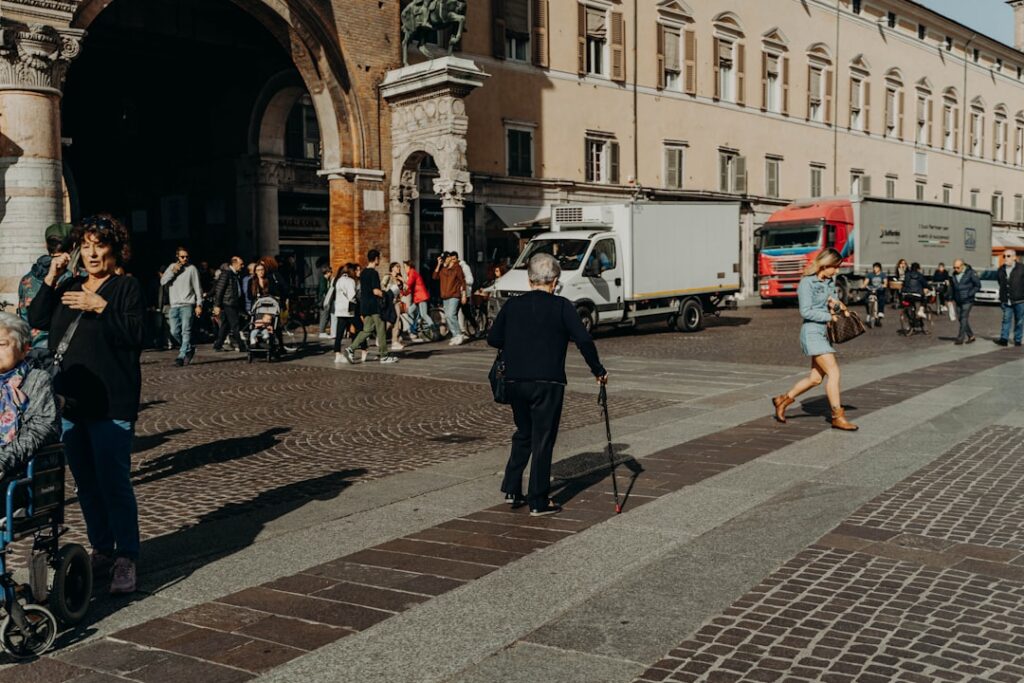
- Many historic city centers (centri storici) have cobblestones — pack a all-terrain pushchair or wheelchair and plan routes using the Wheelmap.org app before you go.
- Ask attraction staff for quiet hours or low-stimulation visit slots — several Italian museums now offer these for visitors with autism or sensory sensitivities.
Packing and Medical Prep
- Carry a translated medical summary (use a certified translator or the MEDIF form) listing your child’s diagnosis, medications, and emergency contacts in Italian.
- Bring a doctor’s letter on headed paper confirming any liquid medications or medical devices, to ease airport and border security checks.
- Pack more medication than needed — Italian pharmacies (farmacia) are excellent, but matching exact formulations of specialist medications can be difficult.
- Download the 112 Where Are U app, Italy’s official emergency service locator, which works for foreign SIM cards and allows silent text-based emergency alerts.
Finding Local Support
- FISH (Federazione Italiana per il Superamento dell’Handicap) maintains a regional directory of disability support services — contact them at info@fishonlus.it before your trip.
- Many Italian tourist offices (IAT offices) now have accessibility coordinators — call ahead and ask to speak with the referente per l’accessibilità.
- Connect with the Turismo Accessibile Italia Facebook group, a community of families sharing real-time tips on accessible restaurants, beaches, and transport across Italian regions.